Discover 1100 grade cookware aluminum circles with excellent formability, food safety, and uniform thickness—ideal for pots, pans, and lids.
1100 grade cookware aluminum circles are disc-shaped blanks made from commercially-pure aluminum (AA1100) widely used as starting stock for cookware blanks — lids, pans, skillets and other spun or deep-drawn vessels.
They combine very high thermal conductivity, excellent formability, low cost and a benign food-contact profile, making them ideal for fast-heating, lightweight cookware and for applications where a post-form surface treatment (anodize, bakeable coating) will add wear resistance.
Cookware manufacturing commonly starts from round blanks cut from coil or sheet stock. These blanks — “circles” — are shaped by spinning, deep drawing or stamping into pots, pans and lids.
Choosing the right alloy and blank specification determines forming success, performance in service (heat-up rate, hot-spot behavior), compatibility with finishing options (anodizing, non-stick coatings), and final product cost.
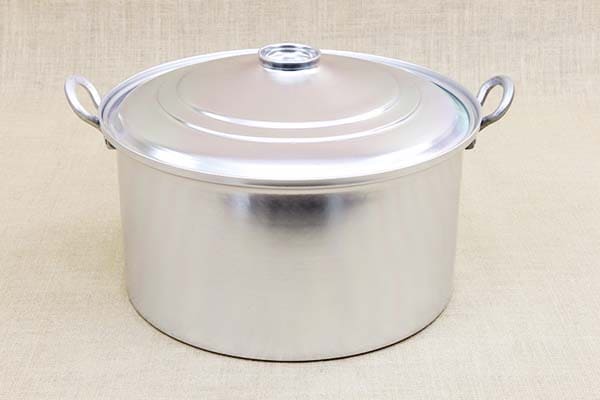
1100 Grade Cookware Aluminum Circles
AA1100 (often shortened to 1100) is a commercially-pure aluminium alloy optimized for high formability and surface quality.
It is not heat-treatable; strength is derived from cold work when required. Typical commercial temper for cookware circles is O (annealed) to maximize ductility for deep drawing and spinning.
| Element | Typical wt.% |
| Aluminum (Al) | Balance (≥ 99.0%) |
| Iron (Fe) | ≤ 0.95 |
| Silicon (Si) | ≤ 0.25 |
| Copper (Cu) | ≤ 0.05 |
| Manganese (Mn) | ≤ 0.05 |
| Zinc (Zn) | ≤ 0.10 |
| Titanium (Ti) | ≤ 0.03 |
Note: exact limits depend on the purchasing standard (ASTM/EN/JIS). Request the supplier’s mill test certificate (MTC).
| Property | Typical value (1100-O) |
| Density | 2.70 g·cm⁻³ |
| Thermal conductivity | ≈ 220–235 W·m⁻¹·K⁻¹ |
| Electrical conductivity | ~55–65% IACS |
| Modulus of elasticity (E) | ≈ 69 GPa |
| Melting range | ≈ 660 °C (solidus/liquidus range) |
| Tensile strength (UTS) | ~65–110 MPa |
| Yield strength (0.2% PS) | ~30–55 MPa |
| Elongation (A%) | ~25–50% (annealed, thickness dependent) |
These properties explain why 1100 is favored where easy forming and rapid, even heat transfer matter.

1100 Aluminum Circles Quality Inspection
Representative cookware blank ranges:
Now that we understand its fundamental properties, let’s connect them directly to the kitchen.
The decision to use 1100 grade cookware aluminum circles is a strategic one, driven by three key performance benefits.
This is arguably the most critical advantage. With a thermal conductivity of approximately 229 W/m·K, 1100 aluminum is a phenomenal conductor of heat.
To put this in perspective, it is more than 14 times more conductive than stainless steel (Type 304, ~16 W/m·K).
Consequently, a pan made from a 1100 aluminum circle heats up rapidly and, more importantly, distributes that heat evenly across the entire cooking surface.
This eliminates “hot spots” that burn food in one area while leaving another undercooked, giving the chef precise temperature control.

Huawei 1100 Grade Cookware Aluminum Circles Warehouse
Cookware often features deep, complex shapes, such as stockpots and saucepans. These are typically formed through a process called deep drawing, where a flat aluminum circle (or “blank”) is pressed into a die to form its shape.
The low tensile strength and high elongation of 1100 aluminum in its softest ‘O’ temper (annealed state) make it exceptionally well-suited for this process. It can be drawn into deep vessels without significant work-hardening, thinning, or cracking, which can be a challenge for stronger, less ductile alloys.
Upon exposure to air, 1100 aluminum naturally forms a thin, dense, and highly stable passive oxide layer (Al₂O₃) on its surface. This layer acts as a protective barrier, preventing further oxidation and corrosion in neutral pH environments.
Furthermore, 1100 aluminum is non-toxic and is widely recognized as a food-safe material, making it an ideal choice for direct contact with ingredients.
A typical supply chain and process flow for cookware circles is:

1100 Grade Cookware Aluminum Circles for Frying Pans
1100 grade aluminum circles are widely adopted across cookware product lines due to their excellent formability, thermal conductivity, and surface compatibility.
Role of 1100 aluminum circles:
1100 aluminum circles are commonly used as the starting blanks for spun or deep-drawn frying pans and skillets, especially in lightweight and mid-range cookware.
Why 1100 is suitable:
Typical specifications:
Role of 1100 aluminum circles:
Used for deeper drawn cookware, such as saucepans, milk pots, and lightweight stockpots, where wall thinning control is important.
Why 1100 is suitable:
Typical specifications:

Pots and Sauce Pans By 1100 Aluminum Circles
Role of 1100 aluminum circles:
1100 aluminum is especially well suited for cookware lids, including flat, domed, or stepped profiles.
Why 1100 is suitable:
Typical specifications:
Role of 1100 aluminum circles:
1100 aluminum circles are used selectively in pressure cooker components, mainly for inner liners, lids, or non-load-bearing parts rather than high-stress vessels.
Why 1100 is suitable:
Typical specifications:

Pressure Cooker Inner Liner
Role of 1100 aluminum circles:
Used in niche or performance-focused cookware, where shape complexity or heat responsiveness is critical.
Examples:
Why 1100 is suitable:
High conductivity shortens heat-up time and reduces temperature gradients across the cooking surface.
High elongation enables large draws and spinning with minimal risk of cracking — important for complex or decorative geometries.
1100’s surface accepts anodizing and non-stick systems reliably after proper pretreatment, enabling durable, easy-clean surfaces.
As a commercially-pure alloy, 1100 is economical versus specialty alloys and reduces processing steps because of its formability.
Low alloy content and established food-contact history make regulatory approval and migration testing simpler than for some complex alloys.
| Parameter | 1100 Aluminum | 3003 Aluminum | 5052 Aluminum | Stainless Steel (304) | Cast Aluminum |
| Alloy / Material type | Commercially pure Al | Al–Mn alloy | Al–Mg alloy | Austenitic stainless steel | Al–Si casting alloy |
| Typical Al content (%) | ≥ 99.0 | ~98.6 | ~97.5 | ~70 (balance Fe/Cr/Ni) | ~85–90 |
| Density (g·cm⁻³) | 2.70 | 2.73 | 2.68 | 7.9 | 2.70 |
| Thermal conductivity (W·m⁻¹·K⁻¹) | 220–235 | 160–190 | 130–150 | 15–25 | 120–160 |
| Formability (drawing / spinning) | Excellent | Very good | Good | Poor | Poor |
| Typical UTS (MPa) | 65–110 | 110–200 | 200–290 | 520–750 | 150–250 |
| Dent / impact resistance | Low–moderate | Moderate | Good | Excellent | Moderate |
| Corrosion resistance (food use) | Excellent | Very good | Excellent | Excellent | Good |
| Surface finishing options | Anodize, non-stick, polish | Anodize, non-stick | Anodize, non-stick | Polish, passivate | Coating only |
| Cookware weight (relative) | Very light | Light | Light | Heavy | Medium |
| Typical cookware use | Spun/drawn pans, lids | Heavier pans, pots | Durable pans, bodies | Clad exteriors, premium pans | Thick pans, casseroles |
| Relative material cost | Low | Low–moderate | Moderate | High | Moderate |
1100 Grade Cookware Aluminum Circles provide a practical, high-performing foundation for many types of cookware.
Their combination of very good thermal conductivity, exceptional formability, favorable finishing characteristics, and cost efficiency makes them especially attractive for spun and deep-drawn pans, lids and lightweight cookware families.
Practical success depends on careful specification of blank dimensions and tolerances, controlled forming practice, and the right surface pretreatment and finishing route (anodize or safe non-stick) to achieve the required wear and safety performance.
Q1 — What thickness should I choose for a 24 cm frying pan blank?
A common starting point is 1.2–1.8 mm for the pan body; the drawn depth and desired rigidity determine the optimal gauge. Heavier, professional pans often use thicker bases or a multi-layer base for better heat retention.
Q2 — Is 1100 safe for food contact?
Yes — AA1100 is widely used in food contact applications. Safety depends also on coatings and processing: require supplier Declaration of Conformity and migration tests for any applied finishes.
Q3 — Can I hard-anodize 1100 for wear resistance?
Yes. Hard-anodizing (thicker anodic oxide) can increase surface hardness and abrasion resistance; typical hard-anodize thicknesses are 15–60 µm, but process parameters must be matched to the substrate and forming route to avoid embrittlement or distortion.
Q4 — How much will a 1100 skillet heat faster than stainless?
Quantitatively, aluminum (≈230 W/m·K) conducts heat orders of magnitude better than stainless (≈15–25 W/m·K). In practice, this means aluminum cookware reaches steady-state heat and responds to power changes much faster; exact time savings depend on geometry and heat source.
Q5 — Should I buy pre-blanked circles or blank in-house from coil?
For high volumes, pre-coated or pre-blanked circles from a converter reduce in-house tooling and improve consistency. For prototyping or low volume, in-house blanking from coil gives flexibility. Consider logistics, storage damage risk, and quality control when choosing.
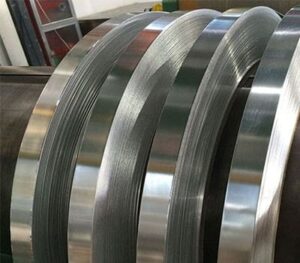
The 3003 aluminium strip is made of 3003 aluminium alloy. The 3 series aluminum alloy is also called an aluminum-manganese alloy.
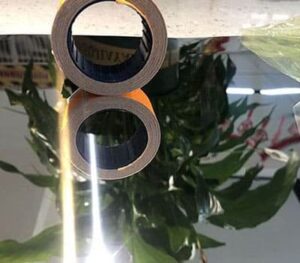
PVD anodizing aluminum mirror sheets is a process where a thin layer of material is deposited onto the surface of the aluminum through a vacuum deposition process.
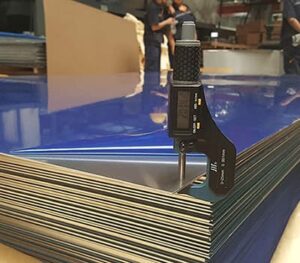
3005 aluminum plate belongs to Al-Mn alloy. The strength of 3005 aluminum plate is about 20% higher than that of 3003 aluminum plate, and its corrosion resistance is also better.
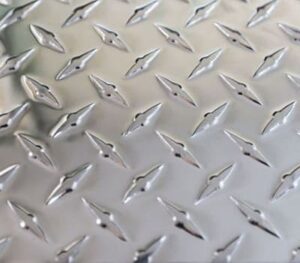
Diamond plate aluminum sheets 4x8 is available in 6061-T6 and 3003-H14 sizes. they have higher strength, wear resistance, load-bearing, machinability, corrosion resistance, etc. Therefore, popular in construction, manufacturing, vehicles, ships and various fields.
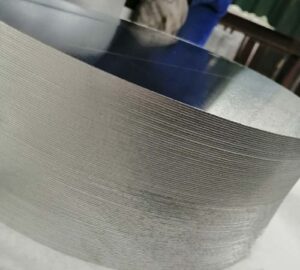
Common aluminium disc circle for lamps are 1050-O, 1060-O, 1100-O, etc., because the lampshade is obtained by stamping aluminum discs, and the O-state aluminum discs have better ductility and are more suitable for stamping treatment;
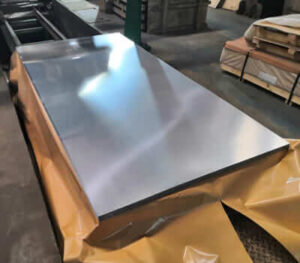
6000 series aluminum alloy is a type of aluminum alloy that is composed of 90-94% aluminum, with the remaining 6-10% consisting of other elements such as magnesium, silicon, and copper.
No.52, Dongming Road, Zhengzhou, Henan, China
Henan Huawei Aluminum Co., Ltd, One Of The Biggest Aluminum Supplier In China Henan,We Are Established In 2001,And We Have rich experience in import and export and high quality aluminum products
Mon – Sat, 8AM – 5PM
Sunday: Closed
© Copyright © 2023 Henan Huawei Aluminium Co., Ltd

Latest Comments
Dear Sir, Please offer your best FOB Prices specs are as under ALUMINIUM STRIP (AL=99.50% MIN) SIZE:450 X32 X6 MM. DIN EN 570 EN-AW 1050 A, QUANTITY=3400KG
Hello, Would you be so kind to offer item as follows: Coil 0,6х1250 (1000)mm EN AW-3105 5tons
Hello, Can you offer me Aluminium plates? Actally I need: 110mm x 1700mm x 1700mm 5083 H111 - 21 pcs Next year planed is 177 pcs
Świetny artykuł. Byłem zachwycony, że wyszukałem ten artykuł. Wielu osobom wydaje się, że mają rzetelną wiedzę na ten temat, ale często tak nie jest. Stąd też moje miłe zaskoczenie. Jestem pod wrażeniem. Zdecydowanie będę rekomendował to miejsce i częściej wpadał, aby zobaczyć nowe rzeczy.
requirement of aluminium strip