Discover the superior performance of 8011 H18 aluminum foil for blister packaging. Delivering exceptional barrier protection, stability, and printability, it ensures reliable sealing and extended drug shelf life.
8011 H18 aluminum foil for blister packaging is a mainstream, workhorse material used globally for pharmaceutical and consumer blisters (push-through lidding).
The 8011 alloy combined with the H18 temper delivers a practical balance of barrier protection, mechanical stability, converting reliability, printability and cost.
For manufacturers and packaging engineers, selecting the correct alloy/temper and specifying appropriate coatings and inspection limits is a core control in ensuring drug stability, patient safety and high-speed production yields.

8011 H18 Aluminum Foil For Blister Packaging
8011 is an 8xxx-series foil alloy formulated for good rolling behavior and surface quality.
Typical composition (weight %) used for packaging-grade 8011:
| Element | Typical range (wt%) |
| Al (balance) | ~97.5 – 99.0 |
| Fe | 0.60 – 1.30 |
| Si | 0.40 – 1.00 |
| Cu | ≤ 0.10 |
| Mn | ≤ 0.10 |
| Mg | ≤ 0.05 |
| Zn | ≤ 0.10 |
| Ti & others | ≤ 0.05 each |
Notes: Fe and Si are the principal minor alloying elements; they improve rolling behavior and toughness and reduce the formation of deleterious inclusions that can cause pinholes. Exact composition varies with supplier—always require a lot-specific Certificate of Analysis (CoA).
Foil properties depend strongly on thickness (gauge) and temper.
The table below gives representative ranges for converter-grade 8011 aluminum foil used in blister lidding.
| Property | Typical (H18 foil, packaging gauges) |
| Thickness (common blister lidding) | 18 – 30 µm |
| Density | 2.71 g/cm³ |
| Tensile strength (Rm) | 85 – 150 MPa (gauge & supplier dependent) |
| Yield strength (Rp0.2) | ≥ 80 MPa |
| Elongation at break | < 5 – 10 % (H18 is low-elongation) |
| Hardness (approx., HRB) | 55 – 65 HRB |
| Thermal conductivity (bulk) | ~200 – 240 W·m⁻¹·K⁻¹ |
| Surface roughness (Ra) | 0.20 – 0.40 µm (converter spec) |
Interpretation: H18 temper produces a high-strength, low-elongation foil suitable for lidding where dimensional stability and resistance to web creep or deformation on the roll are desired.
The H-series tempers indicate cold-worked and stabilized conditions. H18 specifically denotes a fully cold-worked (hard) temper with no subsequent softening anneal. Consequences:
In practice, H18 is an economical and reliable choice for push-through lidding foil where the foil is a flat, sealed cover rather than the formed cavity.
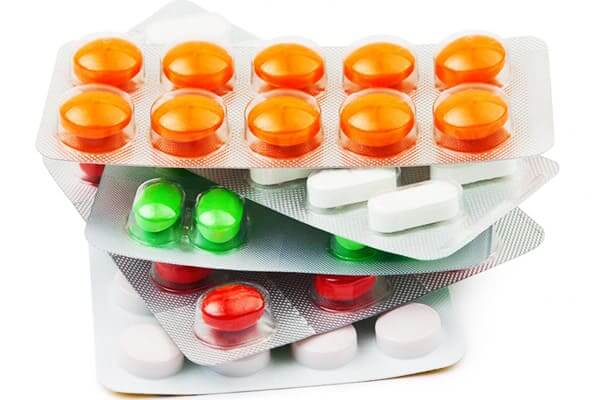
| Application | Typical foil gauge |
| Push-through lidding (pharma consumer) | 18 – 30 µm |
| Tamper-evident / child-resistant lidding | 25 – 35 µm |
| Cold-form (alu-alu) blisters | 8011 H18 generally not preferred; 40–60 µm alloys better suited (8021, 8079) |
Practical note: For blister lidding you select gauge to balance push-through force, puncture resistance and material cost.
Aluminum foil acts effectively as a continuous metallic barrier; specific lab test numbers are for the laminate rather than the pure foil, but typical foil-layer performance is:
Important: final package barrier depends on laminate edges, seal integrity and forming film; OTR/WVTR of the finished blister must be measured per application.

8011 H18 Aluminum Foil For Cold-form blisters
(H18 temper; packaging gauges)

Huawei Packaged 8011 H18 Aluminum Foil
The largest application segment, accounting for ~70% of 8011 H18 blister foil usage. It is used for:
Generic Pharmaceuticals (ibuprofen, paracetamol): 18 μm lids for PVC/PVdC blisters, with over 60% of global generic blisters using this format.
Over-the-Counter (OTC) Drugs (antacids, vitamins): 15–17 μm printable foil with batch number/expiration date.
Cold-Form Blisters (moisture-sensitive antibiotics): 22 μm foil, achieving WVTR ≤0.08 g/(m²·24h). Teva Pharmaceuticals and Mylan are major users, citing 99.5% seal integrity rates.
For premium and shelf-stable foods:
Confectionery (chocolates, mints): 16–18 μm foil blisters, blocking light and moisture to extend shelf life to 12 months (Mars, Ferrero).
Snack Foods (nuts, dried fruits): 18–20 μm foil, preventing oxidative rancidity—Blue Diamond reports 70% reduced rancidity vs. plastic blisters.
Ready-to-Eat Meals (single-serve portions): 20 μm foil for microwave-safe blisters (with PP base).
For small, high-value items:
Electronics Components (microchips, resistors): 20–22 μm foil blisters, protecting against static and moisture—Samsung uses 22 μm foil, reducing ESD failures by 50%.
Cosmetic Samples (serums, foundation): 17–18 μm foil, preserving active ingredients (Estée Lauder, L’Oréal).
Hardware (screws, small tools): 20–25 μm foil for durable, tamper-evident packaging.
| Criterion | 8011 H18 (lidding) | 8021 / 8079 (deep-draw alloys) | 1235 (high-purity) | Metallized PET film |
| Best use | Push-through lidding | Cold-form alu-alu cavities | Ultra-thin lamination | Cost-sensitive pouches |
| Elongation | Low (<10%) | Higher (>15%) | High | Medium |
| Pinhole resistance | Good | Excellent | Moderate | No pinholes (film) but metal coating fragile |
| Formability (deep draw) | Poor | Excellent | Fair | Poor |
| Barrier (metal layer) | Near-absolute | Near-absolute | Near-absolute | Moderate (metal layer can crack) |
| Cost | Moderate | Higher | Low–moderate | Lower |
| Recyclability | Good (aluminum) | Good | Good | Challenging (mixed materials) |
Interpretation: 8011 H18 is the right economic choice for flat lidding, while 8021/8079 are chosen when metal must be formed into cavities (alu-alu). Metallized PET is a lower-cost alternative for non-critical barrier needs.
Huawei Aluminum stands out as a leading supplier of 8011 H18 aluminum foil for blister packaging, offering distinct advantages to global customers:
8011 H18 aluminum foil is a mature, optimized material for blister lidding: it provides industry-proven barrier protection, printability, dimensional stability and production reliability at a competitive cost.
Its H18 temper suits high-speed lidding where dimensional stability out-weighs deep-draw requirements.
Proper specification—gauge, lacquer, pinhole limits, CoA requirements—and supplier qualification are critical to achieving consistent performance and regulatory acceptance.
For cold-form alu-alu cavities or extreme deep-draw needs, select alloys/ tempers engineered for ductility (8021, 8079).
Q1 — Is 8011 H18 suitable for alu-alu cold-form blister packs?
A: No. 8011 H18 has low elongation and is not optimized for deep cold forming; use 8021/8079 or specifically annealed foils for alu-alu forming.
Q2 — What is a typical foil gauge for pharma blister lidding?
A: Most common: 18–30 µm. thicker gauges (25–35 µm) are used for tamper-resistant or child-safe lidding.
Q3 — How is push-through force controlled?
A: By the combination of foil gauge, heat-seal lacquer chemistry and coat weight, seal temperature/pressure/dwell, and blister film geometry. Typical target ranges are 5–12 N depending on patient demographics and regulation.
Q4 — What key QC tests should I require from a foil supplier?
A: Lot CoA (composition/temper/gauge), pinhole inspection report (method defined), coating weight and adhesion data, tensile/elongation data, and traceability documentation. For pharma use, require lacquer E&L baseline and manufacturer GMP evidence.
Q5 — Can 8011 H18 foil be recycled?
A: Yes—aluminum is highly recyclable. However, foils laminated to polymers are more difficult to recycle at municipal sorting streams; recovery at industrial recycling facilities is more feasible.
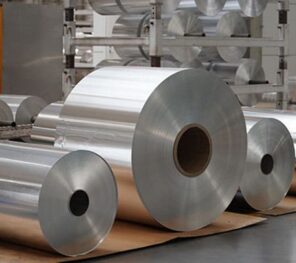
3104 aluminum foil is a specialized alloy in the aluminum industry, renowned for its unique combination of strength, formability, and corrosion resistance. This article explores the chemical composition, mechanical properties, advantages, applications, and comparisons with similar alloys.
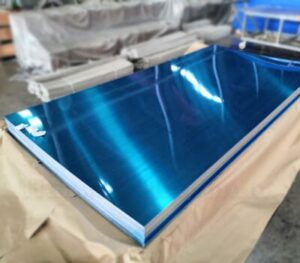
5052 aluminum sheet is part of the 5000 series of aluminum. The grades in this series are alloyed with magnesium (2.5%) and have medium to high strength properties.

Find corrosion-resistant 16 gauge aluminum diamond plate with superior traction. Perfect for marine, automotive, and workshop use — custom cuts available.

The 5052 anodized mirror plate is a type of aluminum sheet that has undergone an anodization process, resulting in a reflective surface. The material is primarily made from 5052 aluminum alloy, which is known for its excellent corrosion resistance and good formability.
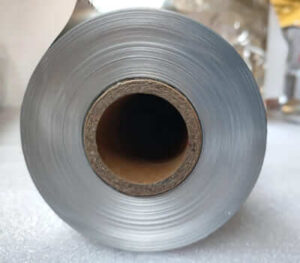
Aluminum foil for hookah is commonly used for preparing and using a hookah, also known as a shisha or water pipe. It serves a specific purpose in the preparation of the hookah, particularly in the placement and management of the charcoal and tobacco.
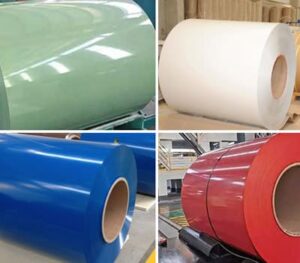
Painted aluminum coil (Coated aluminum coil) is a popular material choice for construction, transportation, and signage due to its lightweight, durability, and versatility.
No.52, Dongming Road, Zhengzhou, Henan, China
Henan Huawei Aluminum Co., Ltd, One Of The Biggest Aluminum Supplier In China Henan,We Are Established In 2001,And We Have rich experience in import and export and high quality aluminum products
Mon – Sat, 8AM – 5PM
Sunday: Closed
© Copyright © 2023 Henan Huawei Aluminium Co., Ltd

Latest Comments
Dear Sir, Please offer your best FOB Prices specs are as under ALUMINIUM STRIP (AL=99.50% MIN) SIZE:450 X32 X6 MM. DIN EN 570 EN-AW 1050 A, QUANTITY=3400KG
Hello, Would you be so kind to offer item as follows: Coil 0,6х1250 (1000)mm EN AW-3105 5tons
Hello, Can you offer me Aluminium plates? Actally I need: 110mm x 1700mm x 1700mm 5083 H111 - 21 pcs Next year planed is 177 pcs
Świetny artykuł. Byłem zachwycony, że wyszukałem ten artykuł. Wielu osobom wydaje się, że mają rzetelną wiedzę na ten temat, ale często tak nie jest. Stąd też moje miłe zaskoczenie. Jestem pod wrażeniem. Zdecydowanie będę rekomendował to miejsce i częściej wpadał, aby zobaczyć nowe rzeczy.
requirement of aluminium strip