Engineer-grade 5052 Aluminum strip for Armored Cable delivers lightweight, corrosion-resistant, non-magnetic. Ideal in H32/H34 tempers for reliable performance.
5052 Aluminum strip for Armored Cable is a magnesium-strengthened, non-heat-treatable alloy widely used for cable armouring in applications that require a balance of mechanical protection, light weight, corrosion resistance and good formability.
This article explains the alloy fundamentals, production and testing of 5052 Aluminum strip for Armored Cable, summarizes the key physical and functional properties that make it suitable for many cable types, compares it to alternative armour materials, and gives practical guidance for selection, specification and supplier evaluation.
Example material data and typical dimensional ranges are provided to support engineering decisions. Where exact numerical limits matter for a contract or a qualified design, use the mill test report (MTR) and the supplier’s certified property tables.

The designation “5052” signifies a wrought aluminum alloy where magnesium is the primary alloying element.
The 5xxx series alloys are known for their excellent strength-to-weight ratio, superior corrosion resistance, and good weldability.
5052 aluminum alloy belongs to the non-heat-treatable Al-Mg system, with composition optimized for cold-work strengthening and environmental durability:
| Element | Content (wt%) | Metallurgical Function |
| Magnesium (Mg) | 2.2–2.8 | Primary solid solution strengthening element; enhances corrosion resistance |
| Chromium (Cr) | 0.15–0.35 | Forms dispersoids (Al₁₈Mg₃Cr₂); controls grain size; improves stress corrosion resistance |
| Iron (Fe) | ≤0.40 | Impurity control; excessive levels reduce ductility |
| Silicon (Si) | ≤0.25 | Impurity; affects castability |
| Copper (Cu) | ≤0.10 | Minimized to prevent galvanic corrosion susceptibility |
| Manganese (Mn) | ≤0.10 | Grain structure control |
| Zinc (Zn) | ≤0.10 | Limited to prevent stress corrosion |
| Aluminum (Al) | Balance | Base matrix |

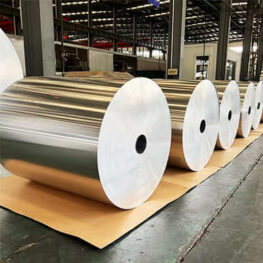
2mm 5052 H32 Aluminum strip
5052 achieves strength through cold work hardening rather than heat treatment, with tempers designated by the H-series system:
| Temper | Work Hardening Degree | Tensile Strength (MPa) | Yield Strength (MPa) | Elongation (%) | Typical Armor Applications |
| O (Annealed) | None | 170–215 | ≥65 | ≥25 | Deep-drawn cable components |
| H32 | 1/4 hard, stabilized | 228–280 | ≥193 | ≥12 | Standard cable armor |
| H34 | 1/2 hard | 241–290 | ≥200 | ≥10 | High-strength armor |
| H36 | 3/4 hard | 255–305 | ≥220 | ≥8 | Heavy-duty industrial cables |
| H38 | Full hard | ≥290 | ≥255 | ≥5 | Maximum strength requirements |
| Property | Value | Significance for Cable Armor |
| Density | 2.68 g/cm³ | 66% lighter than steel; reduces cable weight for installation handling |
| Melting Point | 607–650°C | Maintains structural integrity up to 150°C operational temperature |
| Thermal Conductivity | 138 W/m·K | Facilitates heat dissipation from conductor losses |
| Electrical Resistivity | 0.0495 μΩ·m | Provides electromagnetic shielding (eddy current damping) |
| Thermal Expansion | 23.7×10⁻⁶/K | Compatible with common cable insulation materials |
| Modulus of Elasticity | 69.3 GPa | Flexibility for cable bending without armor buckling |
Possesses excellent deep drawing and bending characteristics. This allows for the precise, helical wrapping around cable cores without cracking or fracturing, which is essential for efficient manufacturing and reliable performance.
The ability to achieve tight bending radii is also beneficial for cable installation.
The production of 5052 Aluminum strip for Armored Cable is a precision-driven process to ensure consistent quality and performance.

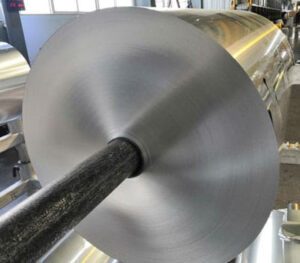
Slitting of 5052 Aluminum strip
5052 provides a combination of compressive resistance, yield strength and ductility that allows effective armour design.
For a given weight, steel often provides higher absolute crush strength, but aluminium’s lighter weight and formability make it attractive where handling and non-magnetic behavior matter.
5052 demonstrates good resistance to atmospheric corrosion and chloride environments, making it suitable for buried or coastal installations when properly protected.
It is not immune to galvanic corrosion when in contact with more noble metals; appropriate isolation and design are required.
Used where non-magnetic armour is required to reduce stray losses and where aluminium conductors are used to match thermal expansion and galvanic behavior.
Spiral or longitudinal 5052 tapes are used to protect multi-core assemblies where moderate mechanical protection and corrosion resistance are sufficient.
5052 tape is used with additional sheath layers for buried cables; for very aggressive soils or industrial chemical exposures, additional protective measures or alternate alloys may be required.
In multi-service environments that require lightweight, corrosion-resistant armour for cable trays and building risers.

Armored cable structure display
| Feature / Material | 5052 Aluminum Strip (H32 Temper) | Galvanized Steel Strip (G.I. Steel) | Stainless Steel Strip (e.g., 304/316) | Pure Aluminum Strip (e.g., 1050/1100) | Non-Metallic (e.g., Aramid Yarns, Glass Fiber) |
| Density (g/cm³) | ~2.68 | ~7.85 | ~7.9 – 8.0 | ~2.70 | ~1.3 – 2.5 (varies) |
| Weight Savings | Excellent (approx. 65-70% lighter than steel) | None (heavy) | Poor (heavy) | Excellent (similar to 5052) | Excellent (often lighter than 5052) |
| Tensile Strength | Good (130-190 MPa yield) | Excellent (250-400+ MPa yield) | Excellent (200-300+ MPa yield) | Fair (30-60 MPa yield) | Good to Excellent (high specific strength) |
| Corrosion Resistance | Excellent (esp. marine/industrial) | Fair to Poor (coating vulnerable) | Excellent | Good | N/A (non-metallic, no metallic corrosion) |
| Magnetic Properties | Non-Magnetic | Magnetic | Magnetic (most common grades) | Non-Magnetic | Non-Magnetic |
| Electrical Conductivity | Good (~35% IACS) | Poor (varies with coating) | Poor (compared to Al) | Excellent (~60% IACS) | N/A (non-conductive) |
| EMI Shielding | Effective | Limited (due to magnetic properties) | Limited (due to magnetic properties) | Effective | N/A (requires metallic layer for shielding) |
| Formability/Ductility | Excellent (for wrapping/bending) | Fair (harder, prone to cracking) | Fair (harder, less flexible) | Excellent | Excellent (highly flexible) |
| Installation Ease | High (lighter, more flexible) | Low (heavy, stiff, harder to terminate) | Low (heavy, stiff, harder to terminate) | High | High (lighter, very flexible) |
| Cost (Material) | Moderate | Low | High | Low to Moderate | High |
| Typical Applications | Telecom, marine, aerospace, control, MV power, data centers | Standard power, general industrial, lower cost | Corrosive chemical plants, specific industrial | Shielding, some low-stress armoring | Specialized fiber optic, lightweight, extreme flexibility |
| Disadvantages | Higher material cost than G.I. steel | Heavy, magnetic, rusts easily once coating compromised | Heavy, magnetic, high cost | Lower strength than 5052 | High cost, different mechanical protection profile, less crush resistance |
A leading global supplier like Henan Huawei Aluminum Co., Ltd (HWALU) provides 5052 Aluminum Strip to strict, internationally recognized standards.

Huawei 5052 Aluminum strip
The 5052 aluminum strip has unequivocally established itself as a premier material for cable armoring in the 21st century.
Its unparalleled combination of lightweight, non-magnetic properties, exceptional corrosion resistance, and robust mechanical performance addresses the critical demands of modern cable infrastructure.
From ensuring signal integrity in telecommunications to extending the lifespan of power cables in harsh marine environments, 5052 offers a technically superior and often more cost-effective solution over the cable’s lifecycle compared to traditional steel armor.
As industries continue to push the boundaries of performance and efficiency, the strategic selection of 5052 Aluminum strip for Armored Cable will remain a cornerstone of reliable and advanced cabling systems worldwide.
Q1: Is 5052 aluminum strip suitable for direct burial cables?
A1: Yes, 5052 aluminum’s excellent corrosion resistance, particularly to moisture and soil conditions, makes it highly suitable for direct burial applications. However, proper outer jacketing is still crucial to protect the entire cable assembly.
Q2: Does 5052 aluminum armor offer EMI shielding?
A2: Yes, the electrical conductivity of 5052 aluminum strip provides effective electromagnetic interference (EMI) shielding, protecting internal signals from external noise and containing internal interference. It also serves as an effective grounding path.
Q3: How does the weight saving of 5052 aluminum compare to steel armoring?
A3: 5052 aluminum has a density of approximately 2.68 g/cm³, while steel is around 7.85 g/cm³. This means 5052 aluminum armor can reduce the weight of the armoring component by roughly 65-70% compared to steel, leading to substantial overall cable weight reduction.
Q4: Can 5052 aluminum strip be used in high-temperature environments?
A4: While 5052 aluminum retains its strength well at room temperature, like all aluminum alloys, its mechanical properties degrade at elevated temperatures (typically above 200°C). For standard cable operating temperatures, it performs excellently. The cable’s insulation temperature rating will usually be the limiting factor.
Q5: What temper of 5052 is most commonly used for cable armoring?
A5: The H32 temper is widely preferred for cable armoring. It offers an optimal balance of strength and ductility (formability), allowing for precise wrapping around the cable core without cracking, while providing sufficient mechanical protection. Other tempers like H34 or H38 may be used for specific requirements needing higher strength but potentially lower ductility.
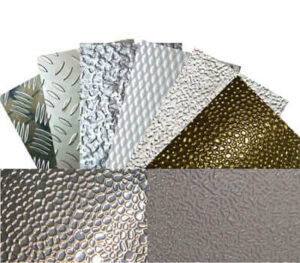
Embossed aluminum sheet is an aluminum product that is rolled on the basis of pure aluminum plate or aluminum alloy plate to form various patterns on the surface.
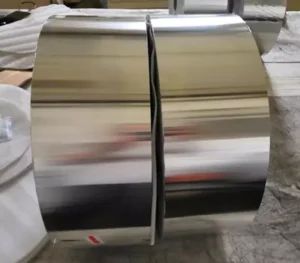
Aluminum Foil For Hair Salon The most common 8011 alloy O Temper, because of excellent strength, flexibility, and heat resistance, Henan Huawei provides you with the best quality 8011-0 aluminum foil for hair salon.
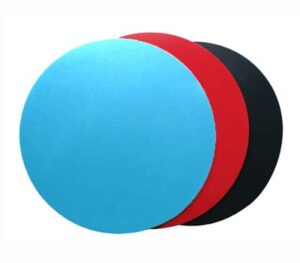
Color coated aluminum circle usually refer to aluminum circles with PE or PVDF coating on the surface, which can not only improve certain anti-corrosion properties but also enhance the appearance of the product.
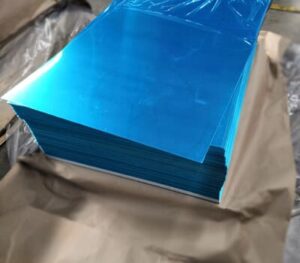
1/8 aluminum sheet is often used in the manufacture of tanks and ships because of its strong hardness and corrosion resistance, etc.
High-adhesion, corrosion-resistant 8011 gold hydrophilic aluminum foil for sealing, lamination, and HVAC applications.
Pharmaceutical foil, also known as medical-grade foil or blister foil, 8011,8021,8079 aluminum foil common used for Pharmaceutical packaging foil.
No.52, Dongming Road, Zhengzhou, Henan, China
Henan Huawei Aluminum Co., Ltd, One Of The Biggest Aluminum Supplier In China Henan,We Are Established In 2001,And We Have rich experience in import and export and high quality aluminum products
Mon – Sat, 8AM – 5PM
Sunday: Closed
© Copyright © 2023 Henan Huawei Aluminium Co., Ltd

Latest Comments
Dear Sir, Please offer your best FOB Prices specs are as under ALUMINIUM STRIP (AL=99.50% MIN) SIZE:450 X32 X6 MM. DIN EN 570 EN-AW 1050 A, QUANTITY=3400KG
Hello, Would you be so kind to offer item as follows: Coil 0,6х1250 (1000)mm EN AW-3105 5tons
Hello, Can you offer me Aluminium plates? Actally I need: 110mm x 1700mm x 1700mm 5083 H111 - 21 pcs Next year planed is 177 pcs
Świetny artykuł. Byłem zachwycony, że wyszukałem ten artykuł. Wielu osobom wydaje się, że mają rzetelną wiedzę na ten temat, ale często tak nie jest. Stąd też moje miłe zaskoczenie. Jestem pod wrażeniem. Zdecydowanie będę rekomendował to miejsce i częściej wpadał, aby zobaczyć nowe rzeczy.
requirement of aluminium strip