Source PE Coated Aluminum Coil for Gutter with reliable formability, corrosion resistance and custom RAL colors. Available in tailored sizes for roll forming.
PE Coated Aluminum Coil for Gutter is a pre-painted aluminum coil designed for the production of rain gutters, downspouts, and other exterior drainage components.
It combines an aluminum substrate with a factory-applied polyester coating, providing a balance of formability, corrosion resistance, appearance, and production efficiency.
Unlike aluminum that receives painting after fabrication, PE coated aluminum arrives with a controlled coating system already applied to the coil.
The material can then enter slitting and roll-forming processes to produce the required gutter profile.
For gutter manufacturers, this approach offers an important production advantage.
The substrate, coating, color, and surface quality can be controlled before forming, while the finished gutter retains a consistent appearance across long production runs.
Gutters operate in a demanding outdoor environment. They experience repeated exposure to rainwater, humidity, temperature changes, airborne pollutants, sunlight, and occasional mechanical impact.
Aluminum provides a naturally corrosion-resistant substrate because it forms a thin protective oxide layer when exposed to air.
A properly designed organic coating adds another level of surface protection while also providing the color and finish required for architectural applications.
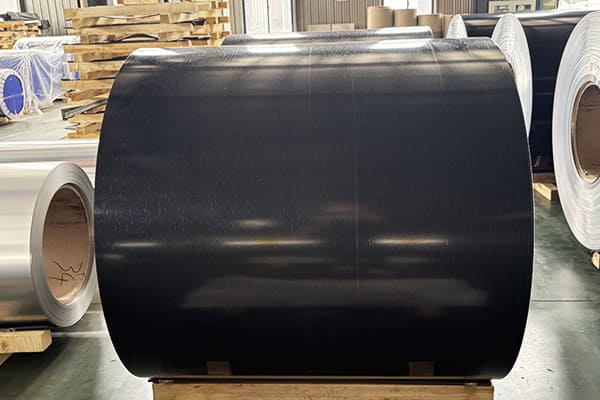
Huawei Black PE Coated Aluminum Coil
PE coated aluminum coil is aluminum coil that receives a polyester-based organic coating, generally through a continuous coil-coating process.
The coating is applied to the aluminum substrate before the material is slit or formed into the final gutter profile.
This allows coating parameters such as color, thickness, curing, and surface appearance to be controlled under continuous production conditions.
A typical PE coated aluminum system can be represented as:
Aluminum Substrate → Surface Pretreatment → Primer → PE Topcoat → Curing → Finished Coated Coil
Depending on the supplier and specification, the coating structure can include different primer, topcoat, backcoat, and protective-film configurations.
The aluminum substrate provides the basic mechanical and forming properties of the gutter material.
For gutter applications, 3xxx-series aluminum alloys such as 3003 and 3105 are commonly considered because they offer a useful combination of formability, strength, and corrosion resistance.
Current gutter-coil product ranges from industry suppliers also commonly specify 3003 and 3105 with H24 or H26 tempers.
The PE topcoat provides the visible surface of the gutter coil.
It determines important characteristics such as:
The coating must remain sufficiently flexible when the aluminum coil passes through the roll-forming equipment.
Rain gutters continuously contact moisture and atmospheric contaminants.
Aluminum provides a corrosion-resistant substrate, while the PE coating provides additional surface protection.
This combination makes coated aluminum suitable for many residential and commercial drainage applications.
However, coating performance still depends on proper pretreatment, coating quality, forming practices, installation, and the actual service environment.
Aluminum offers a relatively low weight compared with many steel-based alternatives.
For gutter manufacturers, lower material weight can simplify coil handling and production-line feeding.
For installers, it can make cutting, positioning, transportation, and installation easier.
The lower weight also helps reduce the load associated with exterior drainage components.
Gutter manufacturing usually involves continuous bending or roll forming.
The coil must pass through multiple forming stations while maintaining its dimensional accuracy and surface appearance.
The aluminum alloy and temper therefore need to provide sufficient ductility for the intended profile.
A suitable PE coating should also tolerate the forming operation without excessive cracking, peeling, or loss of adhesion.
This is why alloy + temper + coating flexibility should be considered together.
Pre-painted aluminum coil gives gutter manufacturers access to a wide range of architectural colors.
Manufacturers can specify standard colors, RAL colors, or project-specific colors depending on the supplier’s capability.
Consistent coating application also helps maintain visual uniformity across long lengths of gutter material.
For residential construction, color can be coordinated with roofs, siding, windows, doors, and fascia.
For commercial projects, the gutter system can be integrated into the overall building color scheme.
Using pre-coated aluminum coil eliminates the need for conventional painting after gutter forming in many production systems.
The manufacturer can purchase the coil in the required width, feed it directly into the forming line, and produce finished profiles with the coating already in place.
A typical production sequence is:
Coated Aluminum Coil → Slitting → Coil Feeding → Roll Forming → Cutting → Finished Gutter
This can simplify production and reduce additional coating operations.
Not every gutter project requires a premium fluoropolymer coating.
For many standard residential and commercial applications, PE polyester coating can provide an appropriate balance between appearance, forming performance, corrosion protection, and material cost.
The correct choice depends on the exposure environment and project requirements rather than coating type alone.

3003 PE Coated Aluminum Coil
Selecting the right aluminum alloy and temper is essential for gutter manufacturing.
The material must provide a practical balance of formability, strength, corrosion resistance, surface quality, and roll-forming performance.
For PE coated aluminum gutter coil, 3003 and 3105 are the most commonly considered grades.
Other alloys such as 5052 or 1100 may also be evaluated for specific applications, but their suitability depends on the gutter profile, forming requirements, and required mechanical properties.
3003 aluminum is an Al-Mn alloy known for good formability, moderate strength, and good general corrosion resistance.
For gutter production, 3003 can provide smooth bending and stable roll-forming performance, making it suitable for profiles with multiple forming operations.
Typical options:
3003 is particularly useful when forming performance is a major consideration.
3105 aluminum is an Al-Mn alloy with magnesium additions.
It offers a useful combination of strength, formability, and corrosion resistance and is widely used in coated building products, including gutter and downspout applications.
Typical options:
For many seamless gutter applications, 3105-H24 and 3105-H26 are practical material choices.
Commercial gutter specifications also commonly identify 3105-H24 for gutter coil and 3105-H26 for applications requiring a harder temper.
5052 aluminum belongs to the 5xxx series and contains magnesium as its primary alloying element.
Compared with common 3xxx-series gutter materials, 5052 can provide higher strength while maintaining good corrosion resistance and forming capability.
It may therefore be considered for heavy-duty or specialized gutter systems where additional strength is required.
Typical options:
However, higher strength does not automatically make 5052 a better choice.
The forming radius, profile geometry, equipment capability, and required springback should be evaluated before changing from a 3xxx-series alloy.
1100 aluminum is a commercially pure aluminum grade with excellent formability and corrosion resistance.
Its relatively low strength limits its use where the finished gutter requires higher rigidity or dent resistance.
Nevertheless, it can be considered for applications where easy forming and high ductility are more important than structural strength.
Typical options:
| Alloy | Series | Common Temper | Formability | Relative Strength | Typical Gutter Application |
| 3003 | 3xxx | H24 / H26 | Good | Moderate | General gutter and downspout |
| 3105 | 3xxx | H24 / H26 | Good | Moderate | PE coated gutter coil and building products |
| 5052 | 5xxx | H32 / H34 | Good | Higher | Heavy-duty or specialized applications |
| 1100 | 1xxx | O / H14 | Excellent | Lower | Light-duty and highly formable products |
Actual mechanical properties depend on thickness, temper, applicable standard, and product specification.
The temper controls the mechanical condition of the aluminum and directly affects strength, ductility, springback, and forming behavior.
For example:
These temper designations are part of the material specification and should be considered together with the alloy and thickness.
H24 and H26 are particularly relevant when selecting gutter coil.
H24 generally offers a useful balance between strength and formability.
It can be suitable for gutter profiles that require repeated bending during roll forming.
H26 provides a harder material condition and higher strength.
It may be considered when the finished gutter requires greater rigidity, provided that the forming equipment can handle the additional hardness and springback.
Therefore, the choice should not simply be “H24 vs. H26.” It should consider:
Gutter Profile → Bending Radius → Thickness → Roll-Forming Equipment → Required Strength → Springback → Final Application
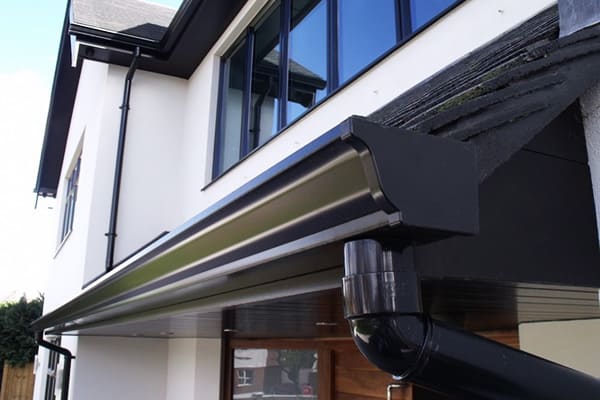
Application of PE Coated Gutter Aluminum Coil
The performance of PE coated aluminum gutter coil depends on more than the aluminum thickness.
A complete specification should define the alloy, temper, thickness, width, coating system, color, coil dimensions, surface quality, and forming requirements.
For gutter manufacturers, the material should match the requirements of the downstream roll-forming equipment and finished gutter profile.
| Specification | Typical / Common Data |
| Product | PE Coated Aluminum Gutter Coil |
| Aluminum Alloy | 3003, 3105,5052,1100,Custom |
| Temper | H24, H26 |
| Thickness | 0.70–1.00 mm commonly used for gutter coil |
| Common Thicknesses | 0.70, 0.80, 0.90, 1.00 mm |
| Parent Coil Width | 610–990 mm |
| Slit Width | Custom according to gutter-forming machine |
| Coating Type | PE Polyester |
| Top Coating Thickness | Typically 15–28 μm, depending on coating system |
| Back Coating | Typically 8–18 μm, depending on specification |
| Color | RAL colors / Custom color matching |
| Surface | Smooth, Gloss, Matte or specified finish |
| Coil ID | Common options include 150, 300, 505 mm |
| Coil OD | According to equipment and coil weight requirements |
| Protective Film | Optional |
| Application | Rain gutters, downspouts, roof drainage systems |
| Applicable Standards | ASTM B209/B209M, EN standards, or customer specification |
| Slitting | Custom precision slitting |
| Packaging | Export seaworthy packaging with moisture and edge protection |
PE coated aluminum gutter coil normally uses a continuous coil-coating process.
This process allows the aluminum substrate and coating system to receive controlled treatment before the material reaches the gutter-forming line.
A typical production route is:
Aluminum Coil → Surface Cleaning → Pretreatment → Primer → PE Topcoat → Curing → Cooling → Inspection → Slitting → Recoiling → Packaging
The manufacturer first selects the required aluminum alloy and temper according to the customer’s specification.
The substrate is inspected for thickness, width, mechanical properties, surface condition, and other relevant requirements before coating.
The aluminum surface must remain clean before coating.
Cleaning removes oil, dust, oxides, and other contaminants that could interfere with coating adhesion.
Stable surface preparation provides a consistent foundation for subsequent pretreatment and coating.
The aluminum strip passes through a controlled pretreatment process.
Pretreatment improves the interaction between the aluminum substrate and coating system and contributes to long-term coating adhesion and corrosion protection.
Process parameters need to remain stable throughout continuous coil production.
A primer is applied to the prepared aluminum surface.
The primer helps establish adhesion between the substrate and the PE topcoat and contributes to the overall performance of the coating system.
The PE polyester coating provides the final visible surface.
During this stage, the manufacturer controls coating application, color, coating uniformity, and surface appearance.
For gutter applications, coating flexibility is particularly important because the material will undergo bending during roll forming.
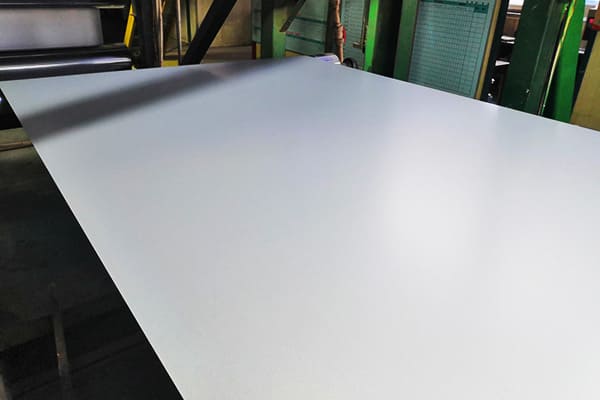
Production of PE Coated Aluminum Coil for Gutter
The coated aluminum passes through a controlled curing zone.
Proper curing develops the required coating properties and helps maintain consistent adhesion, hardness, flexibility, and surface quality.
Insufficient or excessive curing can affect coating performance, so temperature and production speed require careful control.
After curing, the coated strip is cooled and inspected.
Quality control may check:
The master coil can then be slit into the widths required by the gutter-forming line.
Accurate slitting helps control coil feeding and minimize material waste.
The finished coils are rewound with controlled tension to maintain stable coil geometry during transportation and production.
Before shipment, the manufacturer checks the agreed specifications and prepares the coils for transportation.
Export packaging may include moisture-resistant protection, edge protection, suitable wrapping, and reinforced pallets or cradles according to shipping requirements.
For international orders, packaging should protect the coated surface and coil edges from moisture, impact, and handling damage.
| Parameter | PE Coated Aluminum | PVDF Coated Aluminum | Uncoated Aluminum | Painted Steel |
| Base Material | Aluminum | Aluminum | Aluminum | Carbon/Galvanized Steel |
| Common Aluminum Alloy | 3003, 3105 | 3003, 3105 | 3003, 3105, 5005 etc. | — |
| Typical Temper | H24, H26 | H24, H26 | H24, H26 or application-specific | — |
| Typical Gutter Thickness | 0.70–1.00 mm | 0.70–1.00 mm | 0.70–1.00 mm | Typically project-specific |
| Typical PE Topcoat | ≈15–28 μm | — | None | Paint-system dependent |
| Typical PVDF System | — | Usually specified by coating system | — | — |
| Typical Coil Width | Custom; 610–990 mm common in some supply ranges | Custom | Custom | Custom |
| Coil ID | 150 / 300 / 505 mm common options | 150 / 300 / 505 mm common options | Custom | Custom |
| Weight | Low | Low | Low | Higher |
| Formability | Good | Good; forming radius and coating system should be controlled | Good | Moderate to good, depending on grade |
| Corrosion Resistance | Good | Very good to excellent, depending on system and exposure | Good | Strongly dependent on steel coating/paint integrity |
| UV Resistance | Good for suitable PE systems | Generally higher for demanding exterior exposure | No organic coating to fade, but surface appearance changes naturally | Depends on paint system |
| Color Retention | Good; coating system dependent | Generally better for long-term exterior color retention | N/A | Coating dependent |
| Surface Finish | Colored, smooth/gloss/matte options | Colored, smooth/gloss/matte options | Natural metallic aluminum | Painted surface |
| Color Options | RAL/custom colors | RAL/custom colors | Limited | Wide |
| Roll Forming | Suitable | Suitable; control bend radius and forming conditions | Suitable | Suitable |
| Outdoor Exposure | General residential and commercial use | More demanding UV/weather exposure | Basic/natural-finish applications | General to heavy-duty applications depending on coating |
| Maintenance | Generally low | Generally low | Generally low | Depends on corrosion protection |
| Relative Material Cost | Moderate | Higher | Lower than coated aluminum | Varies |
| Main Advantage | Balance of cost, appearance and formability | Higher long-term weathering and color-retention potential | Simple natural aluminum surface | Higher rigidity |
| Main Limitation | PE performance depends on resin, pretreatment, film thickness and exposure | Higher initial coating cost | Limited decorative/color protection | Higher density and greater dependence on coating integrity |
PE coated aluminum coil combines a lightweight aluminum substrate with a factory-applied polyester coating.
The material can be roll formed into continuous gutters, downspouts and other rainwater drainage components while maintaining a consistent exterior finish.
PE coated aluminum coil is widely suited to residential gutter systems.
Manufacturers can use 3003 or 3105 aluminum in suitable tempers and thicknesses, then form the coated coil into K-style, half-round or other gutter profiles.
The pre-painted surface provides multiple color options, allowing the finished gutter to coordinate with roofing, siding, fascia and other exterior elements.

PE Coated Aluminum Coil for Residential Rain Gutters
Seamless gutters require continuous coil feeding and stable roll forming.
PE coated aluminum coil works well for this production method because the material combines good formability with a factory-controlled surface finish.
The coil can be slit to match the feed width required by the gutter-forming machine.
These factors can affect feeding stability, bending behavior and the appearance of the finished gutter.
PE coated aluminum coil can also produce downspouts and related rainwater components.
The coated surface provides a consistent decorative finish while the aluminum substrate offers low weight and good atmospheric corrosion resistance.
Manufacturers can use matching colors for gutters and downspouts to create a consistent drainage system.
Commercial buildings often require longer gutter runs and coordinated exterior finishes.
PE coated aluminum can be used for:
For larger or more demanding projects, buyers should evaluate the gutter profile, structural requirements, environmental exposure and coating system together rather than selecting the material by coating type alone.
Aluminum naturally forms a protective oxide layer, while the PE coating adds an additional barrier between the aluminum surface and the external environment.
For coastal or high-humidity applications, buyers should pay particular attention to:
Where stronger long-term weathering or color-retention performance is required, a PVDF coating system can be considered instead of standard PE.
PE coated aluminum coil is also suitable for customized drainage profiles.
A manufacturer can adjust the coil width, thickness, alloy, temper and color according to the customer’s forming equipment and finished profile.
Current market offerings show that gutter coil can be supplied as parent coil or custom-slit coil, with 3003 and 3105 among the commonly specified alloys.
Henan Huawei Aluminum Co., Ltd. is an aluminum manufacturer and supplier established in 2001, with experience in aluminum sheet, plate, coil, foil, strip and other aluminum products.
The company’s product portfolio also includes coated aluminum and related value-added aluminum processing.
For PE coated gutter applications, Huawei can support customers with material selection and customized aluminum coil specifications based on the downstream forming process.
For gutter manufacturers, a standard aluminum coil is not always the most efficient option.
Huawei can discuss customized requirements such as:
| Specification | Customization |
| Aluminum Alloy | 3003, 3105 and other suitable grades |
| Temper | H24, H26 or application-specific temper |
| Thickness | According to gutter profile and forming requirements |
| Coil Width | Parent coil or customized slit width |
| Coating | PE polyester; other coating systems subject to specification |
| Color | RAL or customer-approved color |
| Surface | Gloss, matte or other agreed finish |
| Coil ID | According to forming equipment |
| Coil Weight | Customized according to handling and machine requirements |
| Packaging | Export seaworthy packaging |
| Inspection | Dimensional, surface and coating inspection |
Huawei’s website identifies aluminum coil and coated aluminum among its key product categories and highlights quality control, technical support and international supply experience.
For PE coated gutter coil, quality control should cover both the aluminum substrate and the coating system.
Huawei can focus inspection on:
This approach helps reduce common production problems such as unstable feeding, edge damage, surface defects and coating damage during roll forming.
Huawei Aluminum has operated since 2001 and supplies aluminum products to international customers.
Its current website states that its products reach 72 countries and that export volume represents a significant part of its business.
For PE coated gutter coil projects, technical communication can cover:
This is particularly useful when the gutter manufacturer needs a customized coil rather than a standard stock specification.
PE coated aluminum coil provides a practical material solution for modern gutter and rainwater drainage systems.
Its main advantages come from the combination of an aluminum substrate and a factory-applied polyester coating.
Aluminum provides low weight, good corrosion resistance and suitable forming performance, while the PE coating provides color, surface protection and a consistent decorative finish.
For gutter manufacturers, material selection should consider the complete production specification, not simply the coating name.
3003 and 3105 are common starting points for gutter coil, but the appropriate alloy and temper depend on the actual gutter profile, forming equipment and required mechanical properties.
For standard residential and commercial applications, PE coated aluminum can provide a useful balance of formability, appearance, corrosion resistance and material cost.
For projects with more demanding long-term exterior exposure and color-retention requirements, buyers can compare PE with PVDF or other higher-durability coating systems.
For customized PE coated gutter aluminum coil, Henan Huawei Aluminum Co., Ltd. can support alloy selection, coil processing, coating requirements, customized dimensions and quality inspection according to the customer’s application and production requirements.
3003 and 3105 aluminum are commonly used because they offer good formability, corrosion resistance and suitable strength for gutter production.
Common specifications are around 0.70–1.00 mm, while the final thickness can be customized according to the gutter profile and forming equipment.
Yes. Customers can customize alloy, temper, thickness, width, coating, color, coil ID and coil weight according to their production requirements.
Yes. It is suitable for producing seamless gutters, downspouts and other drainage profiles. The coil specification should match the forming machine and bending requirements.
Yes. PE coating is suitable for many residential and commercial gutter applications. Actual durability depends on the coating system, pretreatment, exposure conditions and forming process.
PE is commonly selected for general outdoor applications where cost, appearance and forming performance are important. PVDF is more suitable when long-term weathering and color retention are major requirements.
Huawei Aluminum can supply RAL colors and customized colors, subject to the selected coating system and production requirements.
Provide the alloy, temper, thickness, width, coating type, color, coil ID, coil weight and quantity. A gutter profile or forming-machine specification is also helpful.
Yes. Henan Huawei Aluminum Co., Ltd. supports customized aluminum coil specifications, coating requirements, processing, quality inspection and export packaging for different gutter applications.
The market price of 1235 aluminum foil is relatively cheap, and it has become one of the most popular products on the market. It is a common household aluminum foil that can be used as food flexible packaging foil.
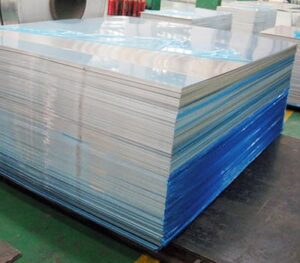
1070 aluminum alloy belongs to the 1000 series pure aluminum with an aluminum content of 99.7%. It is widely used in electronics, electricity, construction, aerospace and other fields.
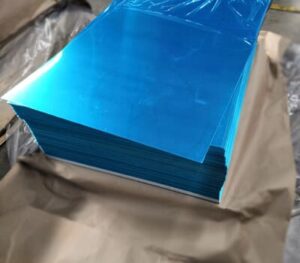
1/8 aluminum sheet is often used in the manufacture of tanks and ships because of its strong hardness and corrosion resistance, etc.
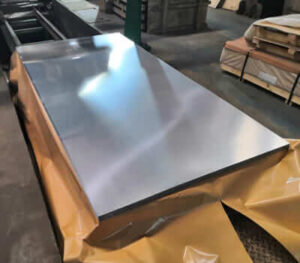
6000 series aluminum alloy is a type of aluminum alloy that is composed of 90-94% aluminum, with the remaining 6-10% consisting of other elements such as magnesium, silicon, and copper.

In-depth guide to 5083 marine aluminium sheet—chemical composition, mechanical strength, corrosion resistance, welding performance, and marine applications.
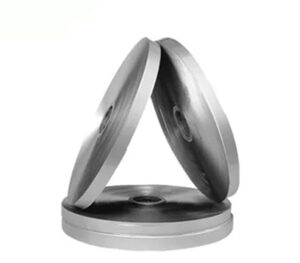
Cable aluminum foil, also known as aluminum foil for cable, refers to a specific type of aluminum foil that is used in the manufacturing of cables and wires.
No.52, Dongming Road, Zhengzhou, Henan, China
Henan Huawei Aluminum Co., Ltd, One Of The Biggest Aluminum Supplier In China Henan,We Are Established In 2001,And We Have rich experience in import and export and high quality aluminum products
Mon – Sat, 8AM – 5PM
Sunday: Closed
© Copyright © 2023 Henan Huawei Aluminium Co., Ltd

Latest Comments
Dear Sir, Please offer your best FOB Prices specs are as under ALUMINIUM STRIP (AL=99.50% MIN) SIZE:450 X32 X6 MM. DIN EN 570 EN-AW 1050 A, QUANTITY=3400KG
Hello, Would you be so kind to offer item as follows: Coil 0,6х1250 (1000)mm EN AW-3105 5tons
Hello, Can you offer me Aluminium plates? Actally I need: 110mm x 1700mm x 1700mm 5083 H111 - 21 pcs Next year planed is 177 pcs
Świetny artykuł. Byłem zachwycony, że wyszukałem ten artykuł. Wielu osobom wydaje się, że mają rzetelną wiedzę na ten temat, ale często tak nie jest. Stąd też moje miłe zaskoczenie. Jestem pod wrażeniem. Zdecydowanie będę rekomendował to miejsce i częściej wpadał, aby zobaczyć nowe rzeczy.
requirement of aluminium strip