Aluminum foil is a versatile and widely used material in various industries, including packaging, insulation, and food preparation. The ability to calculate the precise thickness of aluminum foil is crucial for ensuring consistency in its applications.
Aluminum foil is a versatile and widely used material in various industries, including packaging, insulation, and food preparation. The ability to calculate the precise thickness of aluminum foil is crucial for ensuring consistency in its applications. In this article, we will explore the methods used to calculate the thickness of aluminum foil, the factors that affect its thickness, and how to apply this knowledge in real-world scenarios.

Thickness measurement tools
Aluminum foil thickness usually refers to the vertical cross-sectional dimensions of a single layer of aluminum, and the internationally accepted unit is micrometer (μm) or millimeter (mm). According to industry standards:
Aluminum foil is a thin sheet of aluminum that has been processed through rolling and stretching techniques to achieve a very fine and flexible form. Typically, aluminum foil ranges from 0.006 millimeters (6 microns) to 0.2 millimeters in thickness. The primary aluminum alloy used for foil production is 99.5% pure aluminum, though small amounts of other metals, such as copper, magnesium, and silicon, may be present to enhance strength or flexibility.
Calculating the thickness of aluminum foil is crucial for several reasons:
The most straightforward method to measure the thickness of aluminum foil is using a micrometer or caliper. This tool allows for precise measurement of the foil’s thickness at several points across its surface. Here’s how:

How to calculate thickness of aluminum foil
However, this method can be time-consuming if measuring large quantities of foil or when working with very thin sheets.
The density of aluminum is approximately 2.7 grams per cubic centimeter (g/cm³). If you have a known mass of aluminum foil and its surface area, you can calculate the thickness. Here’s the formula:
Thickness=MassDensity×Surface Area\text{Thickness} = \frac{\text{Mass}}{\text{Density} \times \text{Surface Area}}
This method is useful when you have a sample of foil but lack direct measuring tools.
A micrometer is a precision measuring instrument designed specifically for measuring the thickness of materials with high accuracy. It consists of a screw that moves the measuring surface as you turn the knob. This is ideal for measuring very thin materials like aluminum foil, offering a more accurate reading than calipers.
Another common method is using the volume and surface area of the foil to calculate thickness. By knowing the mass and dimensions of the foil, you can determine its volume and calculate the thickness based on the following formula:
Thickness=VolumeSurface Area\text{Thickness} = \frac{\text{Volume}}{\text{Surface Area}}

Volume-Based Calculation Thickness
This method works well for large sheets where mass and surface area are readily available.
Several factors can influence the final thickness of aluminum foil:
The basic formula for calculating the thickness of aluminum foil, based on mass and surface area, is as follows:
Thickness=MassDensity×Surface Area\text{Thickness} = \frac{\text{Mass}}{\text{Density} \times \text{Surface Area}}
For a rectangular sheet of aluminum foil, where you know the length (L) and width (W), the formula becomes:
Thickness=MassDensity×L×W\text{Thickness} = \frac{\text{Mass}}{\text{Density} \times L \times W}
This calculation assumes that the foil has a consistent density across its entire surface area, which is typically the case for aluminum foil used in most commercial applications.
Let’s say you have a piece of aluminum foil with the following characteristics:
We can calculate the thickness using the formula:
Thickness=MassDensity×L×W\text{Thickness} = \frac{\text{Mass}}{\text{Density} \times L \times W}
First, we calculate the surface area (A):
A=L×W=0.5×0.2=0.1 m2=1000 cm2A = L \times W = 0.5 \times 0.2 = 0.1 , \text{m}^2 = 1000 , \text{cm}^2
Now, substituting values into the formula:
Thickness=102.7×1000=102700=0.0037 cm=0.037 mm\text{Thickness} = \frac{10}{2.7 \times 1000} = \frac{10}{2700} = 0.0037 , \text{cm} = 0.037 , \text{mm}
Thus, the thickness of this piece of aluminum foil is 0.037 mm.
Correct thickness ensures that the aluminum foil will perform its intended function without being too fragile or too bulky. Whether it’s for packaging food or insulating buildings, the right thickness guarantees that aluminum foil:

Huawei aluminum foil jumbo roll
Calculating the thickness of aluminum foil is an essential process for industries that rely on precise material properties. By understanding the various methods available—whether measuring directly, using mass and density, or applying a formula based on surface area—manufacturers can ensure that their products meet quality standards and performance expectations. Whether you are working in aerospace, packaging, or electronics, understanding how to calculate and control aluminum foil thickness is fundamental for optimal results.
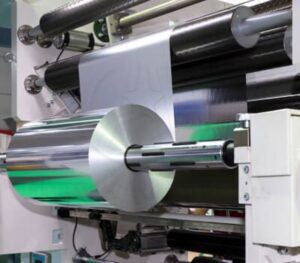
Heavy duty aluminum foil provides extra strength and tear resistance. Many cooks use it for baking, grilling, and storage. Most foil rolls marked "heavy duty" are between 0.0008" and 0.001" thick, which is roughly 0.02032-0.0254mm in national units
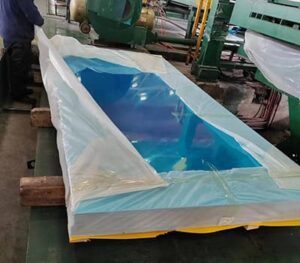
5086 aluminum sheet is a high-strength, corrosion-resistant al-mg alloy, widely used in aerospace, transportation, architectural decoration and other fields.
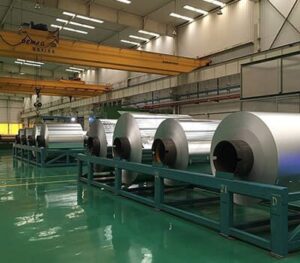
Aluminum alloy 8011 aluminum foil is widely used in aluminum-plastic composite board base tape and food packaging. As a professional aluminum foil 8011 manufacturer in China, Huawei Aluminum has a large 8011 aluminum foil production base and has accumulated more than 20 years of rich aluminum foil production experience and skilled processing technology.
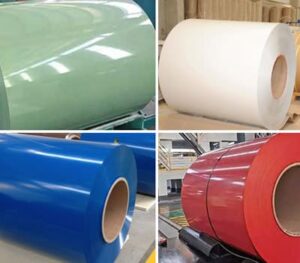
Painted aluminum coil (Coated aluminum coil) is a popular material choice for construction, transportation, and signage due to its lightweight, durability, and versatility.
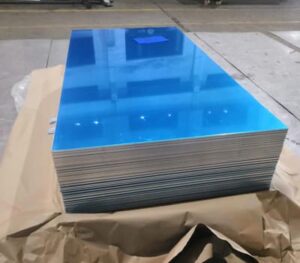
Aircraft Grade Aluminum Sheet Plate is an alloy that has undergone special treatment such as high-temperature oxidation, and can withstand thousands of degrees of high temperature or strong impact.
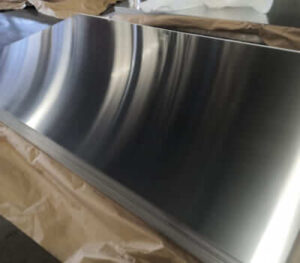
5×10 aluminum sheet is a common specification of aluminum sheet produced by aluminum sheet manufacturers,it is 5 feet wide and 10 feet long.
No.52, Dongming Road, Zhengzhou, Henan, China
Henan Huawei Aluminum Co., Ltd, One Of The Biggest Aluminum Supplier In China Henan,We Are Established In 2001,And We Have rich experience in import and export and high quality aluminum products
Mon – Sat, 8AM – 5PM
Sunday: Closed
© Copyright © 2023 Henan Huawei Aluminium Co., Ltd

Latest Comments
Dear Sir, Please offer your best FOB Prices specs are as under ALUMINIUM STRIP (AL=99.50% MIN) SIZE:450 X32 X6 MM. DIN EN 570 EN-AW 1050 A, QUANTITY=3400KG
Hello, Would you be so kind to offer item as follows: Coil 0,6х1250 (1000)mm EN AW-3105 5tons
Hello, Can you offer me Aluminium plates? Actally I need: 110mm x 1700mm x 1700mm 5083 H111 - 21 pcs Next year planed is 177 pcs
Świetny artykuł. Byłem zachwycony, że wyszukałem ten artykuł. Wielu osobom wydaje się, że mają rzetelną wiedzę na ten temat, ale często tak nie jest. Stąd też moje miłe zaskoczenie. Jestem pod wrażeniem. Zdecydowanie będę rekomendował to miejsce i częściej wpadał, aby zobaczyć nowe rzeczy.
requirement of aluminium strip