Discover 1050 aluminum circle for kitchen industry, pots, pans, and kitchen utensils, offering excellent formability, clean surface quality, and safe food-contact performance.
1050 Aluminum Circle for Kitchen Industry is one of the most widely used aluminum raw materials for cookware and kitchenware manufacturing due to its excellent combination of high aluminum purity, superior thermal conductivity, outstanding deep drawing performance, corrosion resistance, and cost efficiency.
As a typical 1000-series pure aluminum alloy, 1050 aluminum contains at least 99.5% aluminum, giving it excellent ductility and forming capability.
These characteristics make it especially suitable for manufacturing products that require extensive forming processes.
Compared with many alloyed aluminum grades, 1050 aluminum circle provides better thermal conductivity and easier forming performance.
Although its mechanical strength is lower than heat-treatable alloys such as 6061 or strengthening alloys such as 5052, its advantages in deep drawing, surface quality, and processing efficiency make it highly valuable for kitchen applications.

1050 Aluminum Circle for Kitchen Industry
1050 Aluminum Circle for Kitchen Industry is a circular aluminum blank manufactured from AA 1050 aluminum alloy sheet or coil through precision cutting, punching, or blanking processes.
It serves as a key raw material for producing various kitchen products, especially cookware that requires excellent forming performance, efficient heat transfer, and reliable corrosion resistance.
Unlike ordinary rectangular aluminum sheets, aluminum circles are pre-cut into round shapes that match the geometry of many kitchen products.
This design significantly reduces material waste during stamping and deep drawing processes, making them a cost-effective solution for high-volume cookware manufacturing.
1050 aluminum belongs to the 1000 series commercially pure aluminum family.
According to international aluminum alloy standards, AA1050 contains a minimum aluminum content of 99.5%, with only small amounts of alloying elements such as iron and silicon.
Because of its high purity, 1050 aluminum has excellent physical properties, particularly in applications where formability and thermal performance are more important than maximum strength.
Basic Specifications of 1050 Aluminum Circle
| Item | Description |
| Alloy | AA1050 |
| Aluminum Series | 1000 Series Pure Aluminum |
| Aluminum Content | ≥99.5% |
| Density | Approximately 2.70 g/cm³ |
| Melting Point | Approximately 650°C |
| Thermal Conductivity | About 220–230 W/m·K |
| Common Tempers | O, H12, H14, H18 |
| Product Form | Circle / Disc / Round Blank |
| Manufacturing Process | Punching, blanking, stamping |
| Main Application | Cookware and kitchen products |
The combination of high purity and excellent ductility allows 1050 aluminum circles to undergo significant deformation without cracking, which is essential for deep-drawn kitchen products.
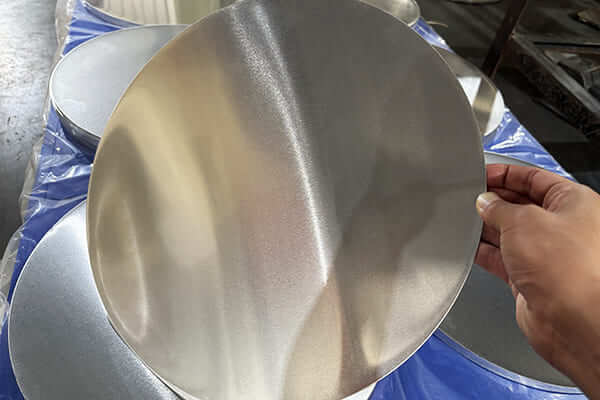
Huawei 1050 Aluminum Circle Display
Choosing the right raw material is critical for kitchen product manufacturers because cookware and kitchen equipment must meet multiple requirements simultaneously, including efficient heat transfer, excellent forming performance, corrosion resistance, food-contact safety, lightweight design, and cost control.
Among various aluminum alloys, 1050 Aluminum Circle for Kitchen Industry has become one of the most commonly selected materials because it provides an ideal balance between manufacturing performance and economic efficiency.
Although 1050 aluminum does not have the highest mechanical strength compared with alloys such as 5052 or 6061, its advantages in thermal conductivity, ductility, and deep drawing performance make it particularly suitable for cookware manufacturing.
One of the most important reasons manufacturers choose 1050 aluminum circles is their excellent ability to transfer heat.
1050 aluminum has a thermal conductivity of approximately:
220–230 W/m·K
This value is significantly higher than many commonly used cookware materials.
| Material | Thermal Conductivity (Approx.) | Relative Heat Transfer Performance |
| 1050 Aluminum | 220–230 W/m·K | Excellent |
| 3003 Aluminum | 160–190 W/m·K | Very Good |
| Copper | 380–400 W/m·K | Excellent |
| Stainless Steel 304 | 14–16 W/m·K | Low |
| Cast Iron | 50–80 W/m·K | Moderate |
Kitchen products often require complex forming operations. A flat aluminum blank must transform into a three-dimensional shape without cracking or surface defects.
Typical forming processes include:
1050 aluminum circles perform exceptionally well in these processes because of their high purity and excellent ductility.
Typical elongation:
20–40%
This means the material can undergo significant deformation before failure.
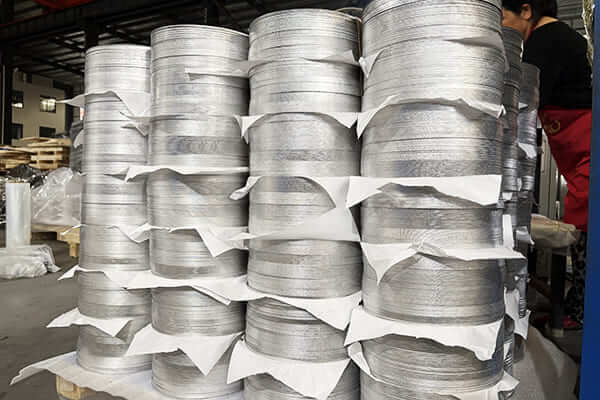
Production of 1050 Aluminum Circle for Kitchen Industry
Kitchen products are frequently exposed to:
1050 aluminum provides reliable corrosion resistance because it naturally forms a dense aluminum oxide film on the surface.
This protective layer helps:
Compared with many steel materials, 1050 aluminum does not require additional corrosion protection for general kitchen applications.
For modern kitchen products, appearance quality is increasingly important.
1050 aluminum circles provide excellent surface characteristics due to their high aluminum purity.
Key advantages include:
They can be processed through:
| Surface Treatment | Purpose |
| Polishing | Improve brightness and appearance |
| Anodizing | Enhance corrosion resistance and surface hardness |
| Non-stick coating | Improve cooking performance |
| Painting | Provide decorative effects |
This makes 1050 aluminum circles suitable for both functional and premium kitchen products.
The density of aluminum is approximately:
2.70 g/cm³
which is about one-third of steel.
| Material | Density (g/cm³) |
| 1050 Aluminum | 2.70 |
| Stainless Steel | 7.9–8.0 |
| Carbon Steel | 7.85 |
Using 1050 aluminum circles allows cookware manufacturers to produce:
At the same time, lightweight design helps reduce material consumption and supports sustainable manufacturing.
For mass-produced kitchen products, material cost and production efficiency are critical.
1050 aluminum provides economic advantages because:
Compared with higher-strength aluminum alloys such as 5052 or 6061, 1050 aluminum is more economical for applications where extreme strength is unnecessary.
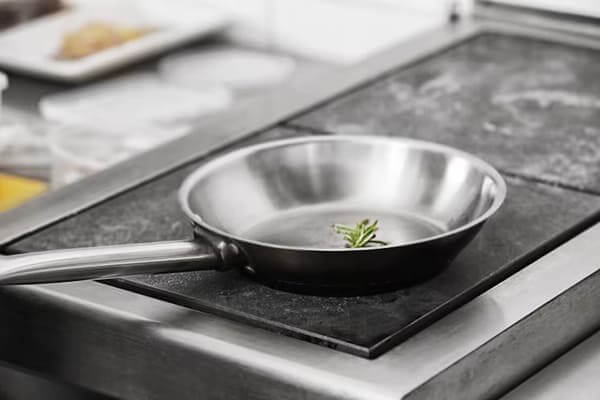
1050 Aluminum Circle for Cooking Pot
1050 aluminum belongs to the commercially pure aluminum family. Its excellent forming characteristics come from its extremely high aluminum content.
| Element | Composition (%) |
| Aluminum (Al) | ≥99.50 |
| Silicon (Si) | ≤0.25 |
| Iron (Fe) | ≤0.40 |
| Copper (Cu) | ≤0.05 |
| Manganese (Mn) | ≤0.05 |
| Magnesium (Mg) | ≤0.05 |
| Zinc (Zn) | ≤0.05 |
| Titanium (Ti) | ≤0.03 |
| Other Elements | ≤0.03 |
Mechanical properties depend strongly on temper conditions.
Unlike heat-treatable alloys, 1050 aluminum gains strength mainly through cold working.
| Property | Typical Value |
| Density | 2.70 g/cm³ |
| Tensile Strength | 75–145 MPa |
| Yield Strength | 20–120 MPa |
| Elongation | 20–40% |
| Elastic Modulus | 69 GPa |
| Thermal Conductivity | 220–230 W/m·K |
The relatively high elongation makes 1050 aluminum especially suitable for deep drawing.
The O temper represents fully annealed aluminum.
Characteristics:
Applications:
Characteristics:
Applications:
Characteristics:
Applications:
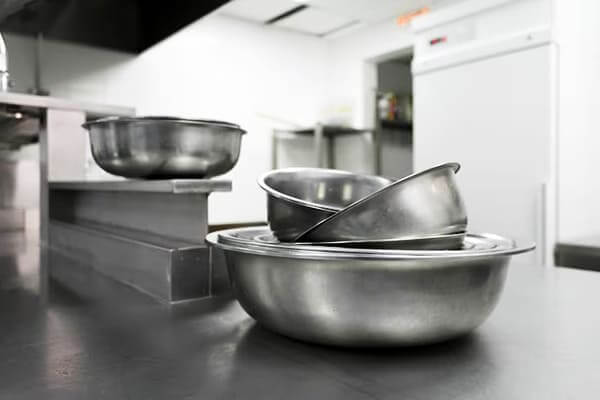
1050 Aluminum Circle for Food Container
Producing high-quality aluminum circles requires strict process control.
The process begins with:
Manufacturers carefully control impurity levels to maintain 1050 alloy requirements.
Hot rolling reduces slab thickness and improves:
Cold rolling provides:
Annealing restores ductility by reducing internal stress.
Benefits:
Aluminum sheets or coils are processed into circles using:
Quality parameters include:
The specifications of 1050 Aluminum Circle for Kitchen Industry are mainly determined by the requirements of the final kitchen product, including forming depth, mechanical strength, heat transfer performance, and manufacturing process.
For cookware applications, manufacturers usually select different diameters, thicknesses, tempers, and surface conditions according to the product design.
| Item | Typical Specification | Description |
| Alloy | 1050 Aluminum | High-purity aluminum alloy with ≥99.5% Al content |
| Temper | O, H12, H14, H18 | O temper is most common for deep drawing cookware |
| Thickness | 0.5–4.0 mm | Selected according to product strength and forming requirements |
| Diameter | 100–800 mm | Customized sizes available according to cookware dimensions |
| Density | 2.70 g/cm³ | Used for weight calculation and material estimation |
| Surface Finish | Mill finish, bright finish, polished finish | Suitable for coating, anodizing, and decorative processing |
| Edge Condition | Smooth edge, burr-free | Prevents cracking during stamping and improves safety |
| Packaging | Wooden case, pallet, export package | Protects surface quality during transportation |
| Kitchen Application | Recommended Thickness Range | Common Temper | Key Requirements |
| Frying Pan | 0.8–3.0 mm | 1050-O / H12 | Excellent deep drawing and heat distribution |
| Cooking Pot | 1.0–3.5 mm | 1050-O | Good forming performance and structural stability |
| Pressure Cooker | 1.5–4.0 mm | 1050-O / H12 | Higher thickness for safety and durability |
| Baking Tray | 0.6–2.0 mm | H12 / H14 | Lightweight and good surface quality |
| Food Container | 0.5–2.0 mm | O / H12 | Easy forming and corrosion resistance |
| Kitchen Utensils | 0.8–2.5 mm | O / H14 | Good appearance and processing performance |
| Product Type | Typical Diameter | Application Example |
| Small Kitchenware | 100–250 mm | Small containers, bowls, lids |
| Medium Cookware | 250–500 mm | Frying pans, saucepans |
| Large Cookware | 500–800 mm | Large pots, commercial kitchen equipment |
| Final Product | Recommended 1050 Aluminum Circle Specification |
| Household Frying Pan | 1050-O, 1.0–2.5 mm thickness, 200–400 mm diameter |
| Deep Cooking Pot | 1050-O, 1.5–3.5 mm thickness, 300–600 mm diameter |
| Pressure Cooker Body | 1050-O, 2.0–4.0 mm thickness, 300–500 mm diameter |
| Aluminum Baking Tray | 1050-H12/H14, 0.8–1.5 mm thickness |
| Food Container | 1050-O, 0.5–1.5 mm thickness |
When selecting aluminum circles for kitchen applications, manufacturers usually compare 1050 aluminum with other commonly used alloys such as 3003, 5052, and 6061.
Each alloy has different advantages in terms of strength, thermal conductivity, formability, corrosion resistance, and cost.
For cookware and kitchen products, 1050 Aluminum Circle for Kitchen Industry is generally preferred when excellent deep drawing performance, heat transfer efficiency, and cost control are the primary requirements.
| Property | 1050 Aluminum Circle | 3003 Aluminum Circle | 5052 Aluminum Circle | 6061 Aluminum Circle |
| Alloy Series | 1000 Series (Pure Aluminum) | 3000 Series (Al-Mn Alloy) | 5000 Series (Al-Mg Alloy) | 6000 Series (Al-Mg-Si Alloy) |
| Main Alloying Elements | Al ≥99.5% | Mn | Mg | Mg + Si |
| Density (g/cm³) | 2.70 | 2.73 | 2.68 | 2.70 |
| Tensile Strength (MPa) | 75–145 | 120–160 | 210–260 | 260–310 |
| Thermal Conductivity (W/m·K) | 220–230 | 160–190 | 130–160 | 150–170 |
| Formability | Excellent | Excellent | Good | Moderate |
| Deep Drawing Performance | Excellent | Very Good | Good | Limited |
| Corrosion Resistance | Excellent | Excellent | Superior | Good |
| Weldability | Excellent | Excellent | Excellent | Good |
| Machinability | Moderate | Moderate | Good | Excellent |
| Surface Quality | Excellent | Very Good | Good | Good |
| Relative Cost | Low | Medium | Higher | Higher |
| Typical Kitchen Applications | Frying pans, pots, baking trays, containers | Durable cookware, pressure cookers | Heavy-duty cookware, marine products | Structural components, precision parts |
For kitchenware manufacturers, the quality of aluminum circles directly affects forming performance, production efficiency, product appearance, and final product reliability.
As a professional aluminum manufacturer, Henan Huawei Aluminum Co., Ltd applies a comprehensive quality control system throughout the entire production process of 1050 Aluminum Circle for Kitchen Industry, from raw material selection to final inspection.
The chemical composition of 1050 aluminum directly determines its purity, forming ability, corrosion resistance, and surface performance.
Henan Huawei Aluminum conducts chemical composition analysis on raw materials and finished products to ensure compliance with international standards such as:
Key Elements Controlled in 1050 Aluminum
| Element | Typical Requirement (%) | Quality Influence |
| Aluminum (Al) | ≥99.50 | Determines purity, ductility, and conductivity |
| Iron (Fe) | ≤0.40 | Excessive Fe may reduce surface quality |
| Silicon (Si) | ≤0.25 | Affects forming performance and microstructure |
| Copper (Cu) | ≤0.05 | Controlled to maintain corrosion resistance |
| Manganese (Mn) | ≤0.05 | Improves material stability |
| Magnesium (Mg) | ≤0.05 | Maintains pure aluminum characteristics |
Accurate chemical composition control helps ensure:
Although 1050 aluminum is not a high-strength alloy, its mechanical properties are critical for stamping and deep drawing processes.
Henan Huawei Aluminum performs mechanical tests to verify that aluminum circles meet customer requirements.
Main Mechanical Tests
| Test Item | Purpose |
| Tensile Strength Test | Evaluate material strength under load |
| Yield Strength Test | Determine deformation resistance |
| Elongation Test | Verify forming capability |
| Hardness Test | Check temper consistency |
Typical mechanical properties of 1050 aluminum circle:
| Property | Typical Value |
| Tensile Strength | 75–145 MPa |
| Yield Strength | 20–120 MPa |
| Elongation | 20–40% |
| Density | 2.70 g/cm³ |
Accurate dimensions are essential for automatic stamping lines and high-volume cookware production.
Even small variations in thickness or diameter can influence:
Henan Huawei Aluminum performs strict dimensional inspections on every production batch.
Surface quality is a key factor for kitchen products because aluminum circles often undergo:
Poor surface quality may cause defects in the final cookware appearance.
Henan Huawei Aluminum carefully inspects aluminum circle surfaces to ensure:
Common Surface Inspection Items
| Inspection Item | Requirement |
| Scratches | Controlled or eliminated |
| Oil stains | Not allowed |
| Oxidation marks | Avoided |
| Black spots | Strictly controlled |
| Edge cracks | Not permitted |
| Surface roughness | Controlled according to application |
1050 Aluminum Circle for Kitchen Industry remains one of the most important aluminum materials for cookware manufacturing because it provides an excellent balance of:
Although alloys such as 3003 and 5052 offer higher strength, 1050 aluminum continues to dominate applications where forming performance and heat transfer are more important than maximum strength.
For kitchenware manufacturers, selecting a reliable supplier and the correct specification—including alloy temper, thickness, diameter, and surface condition—is essential for improving production efficiency and reducing manufacturing costs.
With professional manufacturing experience and strict quality management, suppliers such as Henan Huawei Aluminum Co., Ltd provide reliable 1050 aluminum circles that meet the demanding requirements of global kitchen industry customers.
Q1: Why is 1050 aluminum circle widely used for cookware?
Because it has excellent thermal conductivity, deep drawing ability, corrosion resistance, and good surface quality.
Q2: What temper is commonly used for kitchen aluminum circles?
The most common temper is 1050-O because it provides maximum ductility and excellent forming performance.
Q3: What thickness is suitable for frying pans?
Typical thickness ranges from 0.8 mm to 3.0 mm, depending on product design and strength requirements.
Q4: Is 1050 aluminum food safe?
Yes. High-purity aluminum such as 1050 is widely used in food-related applications when processed according to relevant standards.
Q5: What is the difference between 1050 and 3003 aluminum circle?
1050 provides better thermal conductivity and formability, while 3003 offers higher strength and durability.
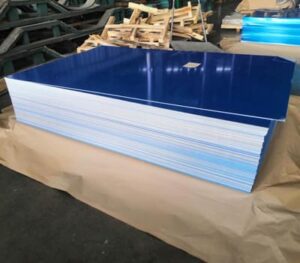
5454 aluminum sheet has strong anti-rust ability and belongs to the 5000 series aluminum-magnesium alloy. 5454 aluminum sheet is also a non-heat treatable alloy and is 20% stronger than 5052 aluminum sheet. It is often used in marine facilities pipelines, aluminum tank car bodies and other fields.
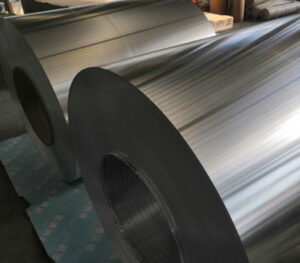
Contact us today to learn more about our 5083 aluminum coil offerings and how we can meet your specific requirements.
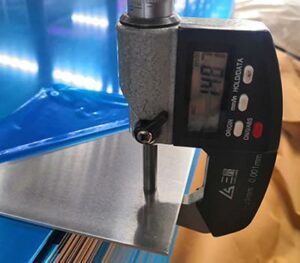
3A21 aluminum plate is an Al-Mn series aluminum alloy, which belongs to the weldable LF21 aluminum alloy and is known for its excellent anti-rust properties.
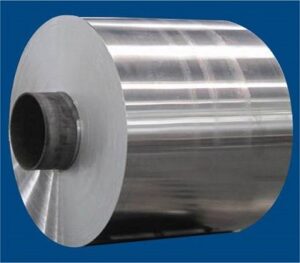
Professional aluminum foil alloy manufacturer, direct selling price supply, the most trustworthy supplier in China best price for sale
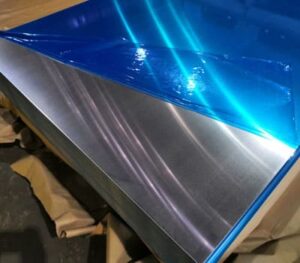
The 6063 aluminum sheet is a 6000-series aluminum alloy with magnesium and silicon as the main alloying elements. The strength of the 6063 alloy is lower than that of the 6061 alloy, and it has good extrudability, corrosion resistance, and good surface treatment performance.
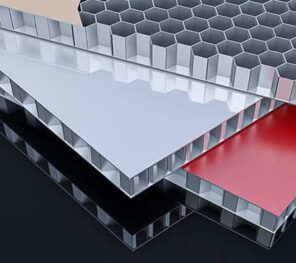
Aluminum honeycomb panels are a type of composite material inspired by the hexagonal honeycomb structure found in nature. These panels are renowned for their lightweight, high strength, and versatility, making them a popular choice in various industries, from construction to aerospace.
No.52, Dongming Road, Zhengzhou, Henan, China
Henan Huawei Aluminum Co., Ltd, One Of The Biggest Aluminum Supplier In China Henan,We Are Established In 2001,And We Have rich experience in import and export and high quality aluminum products
Mon – Sat, 8AM – 5PM
Sunday: Closed
© Copyright © 2023 Henan Huawei Aluminium Co., Ltd

Latest Comments
Dear Sir, Please offer your best FOB Prices specs are as under ALUMINIUM STRIP (AL=99.50% MIN) SIZE:450 X32 X6 MM. DIN EN 570 EN-AW 1050 A, QUANTITY=3400KG
Hello, Would you be so kind to offer item as follows: Coil 0,6х1250 (1000)mm EN AW-3105 5tons
Hello, Can you offer me Aluminium plates? Actally I need: 110mm x 1700mm x 1700mm 5083 H111 - 21 pcs Next year planed is 177 pcs
Świetny artykuł. Byłem zachwycony, że wyszukałem ten artykuł. Wielu osobom wydaje się, że mają rzetelną wiedzę na ten temat, ale często tak nie jest. Stąd też moje miłe zaskoczenie. Jestem pod wrażeniem. Zdecydowanie będę rekomendował to miejsce i częściej wpadał, aby zobaczyć nowe rzeczy.
requirement of aluminium strip